Fletcher Lynd Seagull
Jonathan Livingston SeagullFletcher Lynd Seagull is a young, fiercely ambitious gull whose expulsion from the Flock leads him to Jonathan Livingston Seagull and a new understanding of flight. He begins as an angry outsider convinced that the Flock has punished him unjustly; through strenuous training, he becomes both a learner and a teacher, carrying Jonathan’s work forward after his mentor vanishes.
Identity and Exclusion
Fletcher is still young when he is cast out, but he already judges the Flock’s treatment of him as exceptionally harsh and unjust. His offense was a barrel-roll around the Elder Gull, performed for fun. To Fletcher, the punishment exposes the narrowness of the flock’s standards: flight is more than moving from place to place, and its glory lies in what gulls might learn to do. He resolves to live as an outlaw and prove that the Flock is wrong.
That conviction does not make his exclusion easy. As he flies toward the Far Cliffs, his vision blurs with anger; the image of becoming a pure outlaw carries both defiance and hurt. His rejection sets him apart from the community, but it also leaves him able to meet a different possibility when Jonathan’s voice asks whether he wants to fly—and whether he is willing to forgive the Flock, learn, and someday return to help it learn.
Training Under Jonathan
Fletcher answers that he wants to fly. Jonathan begins with level flight, and Fletcher proves an unusually promising student: strong, light, quick in the air, and, most important to his instructor, driven to learn. That drive is not effortless mastery. During one lesson he rushes out of a dive at 150 miles per hour and attempts a sixteen-point vertical slow roll, calling out each point. At the top, he loses airspeed, whipstalls, tumbles into an inverted spin, and recovers a hundred feet below Jonathan, panting and convinced that he is too stupid to succeed.
Jonathan answers with specific correction rather than reassurance alone. Fletcher has lost forty miles per hour in the entry, he explains, and is making the pull-up too hard. The motion must be firm but smooth. Instead of leaving Fletcher to repeat the maneuver by himself, Jonathan drops to his level and proposes that they try it together in formation, with a smoother, easier entry. Their teaching relationship is made of this close exchange: a demanding attempt, a precise diagnosis, and a shared repetition that turns failure into instruction.
The education extends beyond Fletcher. By the end of three months Jonathan has six other students, all Outcasts, drawn by the unfamiliar idea of flying for the joy of flying. Their ability to perform advanced maneuvers develops more readily than their grasp of what those maneuvers mean. Jonathan teaches that each gull is an unlimited idea of freedom and that precision flight can express this nature; the practice is therefore at once physical discipline and a lesson in seeing beyond imposed limits.
From Student to Teacher
Fletcher’s early success belongs to a broader pattern of learning that joins technique to a changed sense of possibility. In Jonathan’s own training, formation point-rolls require him to think upside down and reverse the curve of his wings in exact harmony with Sullivan. Later, Chiang tells Jonathan that the next work will involve time and, beyond it, learning kindness and love. These lessons establish a world in which flight can exceed ordinary bodily and spatial limits, while also insisting that technical advancement alone is not the final aim.
The practice begins to attract gulls beyond Jonathan’s original circle. At night, curious members of the Flock gather at a distance to listen to the students, avoiding one another’s notice and disappearing before daybreak. A month after the Outcasts’ return, Terrence Lowell Gull crosses the line to ask for flying lessons; the request makes him an Outcast and the eighth student. The next night Kirk Maynard Gull arrives dragging his left wing, collapses at Jonathan’s feet, and asks for help because he wants to fly more than anything. These episodes show how instruction reaches into the community that had rejected the students: one learner’s request can repeat the social risk that began Fletcher’s own path.
Fletcher’s later role is defined by that risk and by what he has learned to do with it. When the Flock has tried to kill Jonathan and Fletcher, Fletcher asks how Jonathan can still love a mob that has just attacked them. Jonathan’s answer is not a withdrawal into private mastery. The question recalls the earlier charge that a true student must forgive the Flock and return to help it learn. Fletcher thus comes to understand the return not as surrendering his judgment about the Flock, but as continuing the work of teaching despite its hostility.
Succession and Legacy
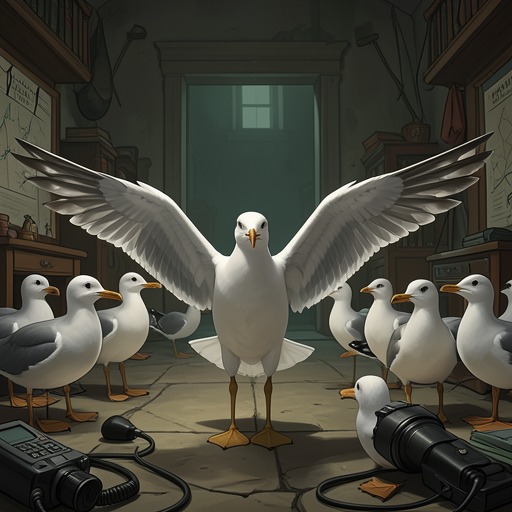
After a time, Fletcher drags himself into the sky and faces a brand-new group of eager students. His body is still marked by what has happened, but he has taken up the teaching role. He tells them that a gull is an unlimited idea of freedom, an image of the Great Gull, and that the whole body, from wingtip to wingtip, is thought itself. This is a substantial change from the angry young outcast who wanted to prove the Flock wrong: Fletcher now has responsibility for conveying a principle that reaches beyond the mechanics of any one maneuver.
The new students look at him quizzically. They had expected a rule for a loop, not a lesson about freedom, thought, and the nature of a gull. Their reaction preserves the gap that marked Jonathan’s first teaching circle: students can arrive seeking technique before they understand its meaning. Fletcher inherits not a completed doctrine but the challenge of guiding learners through that gap, as Jonathan guided him through the difficult roll by joining precise feedback to continued practice.
Fletcher’s arc is therefore both a conversion and a succession. Exclusion first gives him a reason to resist the Flock; instruction gives him a way to understand flight as more than performance; the demand to forgive and return redirects his independence toward service. His new class confirms the consequence of that change: the outcast becomes a teacher, and the lessons that once reached him at the Far Cliffs begin again with another generation of gulls.